Blog

  • Can Technology Make Cities Smarter Without Making Them More Vulnerable?

    Can Technology Make Cities Smarter Without Making Them More Vulnerable?

    As urban environments become more connected, the challenge is no longer simply adopting new technology. It is making sure all that connectivity remains secure, resilient and useful. 

    The United Nations projects that 68% of the world’s population is projected to live in urban areas by 2050, with around 2.5 billion people expected to be added to urban populations between 2018 and 2050. That growth will place greater demands on infrastructure and services, from transport and energy to healthcare, public services and communications. 

    Technology will inevitably play a major role in meeting those demands. Connected infrastructure can help cities understand how people and assets move, respond more quickly to incidents, allocate resources more effectively and make better-informed decisions. 

    But there is another side to that equation. The more connected an urban environment becomes, the more dependent it becomes on the security and resilience of those connections. 

    That makes “smart security” less about adding another layer of technology and more about asking a fundamental question: how do we make increasingly intelligent environments dependable when something goes wrong? 

    The security challenge is becoming more interconnected 

    A modern city does not operate as a collection of isolated systems. Cameras feed information into video management platforms. Access control systems determine who can enter buildings and restricted areas. Traffic systems monitor movement. Sensors generate information about infrastructure and the environment. Control rooms bring multiple sources together to support decision-making. 

    The UK’s National Cyber Security Centre (NCSC) describes a connected place in much the same way: an environment where sensors, networks and applications collect and analyse data across areas including transportation, buildings, utilities, infrastructure and public services.  

    These systems can create significant operational benefits. They can also create dependencies. 

    A failure in one system may have consequences somewhere else. A compromised device can potentially provide a route into a wider network. Poorly understood connections can create gaps in visibility. And information that sits in separate systems is of limited value when the people responsible for responding to an incident cannot access or interpret it quickly. 
     
    The NCSC’s Connected Places Cyber Security Principles recommend identifying, understanding and assessing the interdependencies within a connected place, including its users, devices, services, data and connections.  

    Security cannot be an afterthought 

    The UK Government has developed dedicated guidance for securing connected places, covering areas including resilience, architecture, data protection, system administration, incident response, procurement and supply-chain management.  

    The NCSC’s guidance is similarly clear that security needs to be considered across the design, build and management of a connected place. Its principles cover everything from understanding the environment and its risks to designing secure architecture, managing privileges and planning response and recovery.  

    That principle becomes increasingly relevant as cities move from individual technology projects towards interconnected environments. Security needs to be considered at the point of design, rather than treated as something that can be bolted on once the technology is operational. 

    The NCSC specifically recommends designing connected-place architecture so that the impact of a component failure or cyber-attack can be localised, with appropriate boundaries and failover options in place  

    Visibility matters, but context matters more 

    A connected environment can generate enormous amounts of information. The challenge is turning that information into something useful for the people making decisions. AI-enabled analytics, automated detection and integrated platforms can help identify patterns or events that might otherwise be missed. But technology should support human judgement rather than simply produce more alerts. 

    A security team does not necessarily need to know that 500 events occurred, it needs to understand which one matters, why it matters and what should happen next. That distinction becomes particularly important in environments such as transport networks, critical infrastructure and public spaces, where security teams may need to make decisions quickly and with incomplete information. 

    The NCSC’s guidance on connected-place monitoring makes a similar distinction. It recommends establishing a baseline of normal operations so that organisations can identify abnormalities and better distinguish meaningful events from false ones.  

    Resilience is the real measure of a smart system 

    Perhaps the most useful way to think about smart security is to move beyond prevention. No system is likely to be completely immune to failure, attack or disruption. The more useful question is what happens when something does go wrong. 

    • Can an organisation detect the problem quickly? 
    • Can it maintain essential services? 
    • Can security teams understand what is happening? 
    • Can different departments work from the same information? 
    • Can systems be isolated without bringing critical operations to a halt? 
    • And can the organisation recover without losing the trust of the people who rely on those services? 

    The UK Government’s connected-places guidance highlights the need to design systems to be resilient to cyber-attacks and other security events, while NCSC guidance covers resilience, lifecycle management, incident response and recovery.  

    The conversation needs to move beyond technology 

    The next stage of smart-city development will undoubtedly bring new technologies, greater automation and more connected infrastructure. But the strongest security strategies will not necessarily be the ones with the most technology. They will be the ones that understand how technology, people, processes and physical environments interact. 

    That means security professionals, technology providers, infrastructure owners, public authorities and other stakeholders need to be part of the same conversation much earlier. It means measuring success not by how much technology has been deployed, but by whether that technology helps an organisation see more clearly, decide more effectively and continue operating when conditions change. 

    That is where the idea of smart cities and smart security really comes together. The future of urban security will not simply be about making cities more connected. It will be about making those connections trustworthy enough to rely on. 

    Continuing the conversation at ConSeC 26 

    These questions sit at the heart of the theme for ConSeC 26: “Smart Cities – Smart Security: Where Urban Innovation Meets Intelligent Solutions.” 

    The conference will bring together professionals working across security, technology and the wider built environment to explore how innovation is changing the way urban security is designed, delivered and managed. 

    ConSeC 26 takes place on 29th October 2026 at Hinxton Hall Conference Centre. 

    Register your interest now: https://ascuk.org/event/consec-26/ 
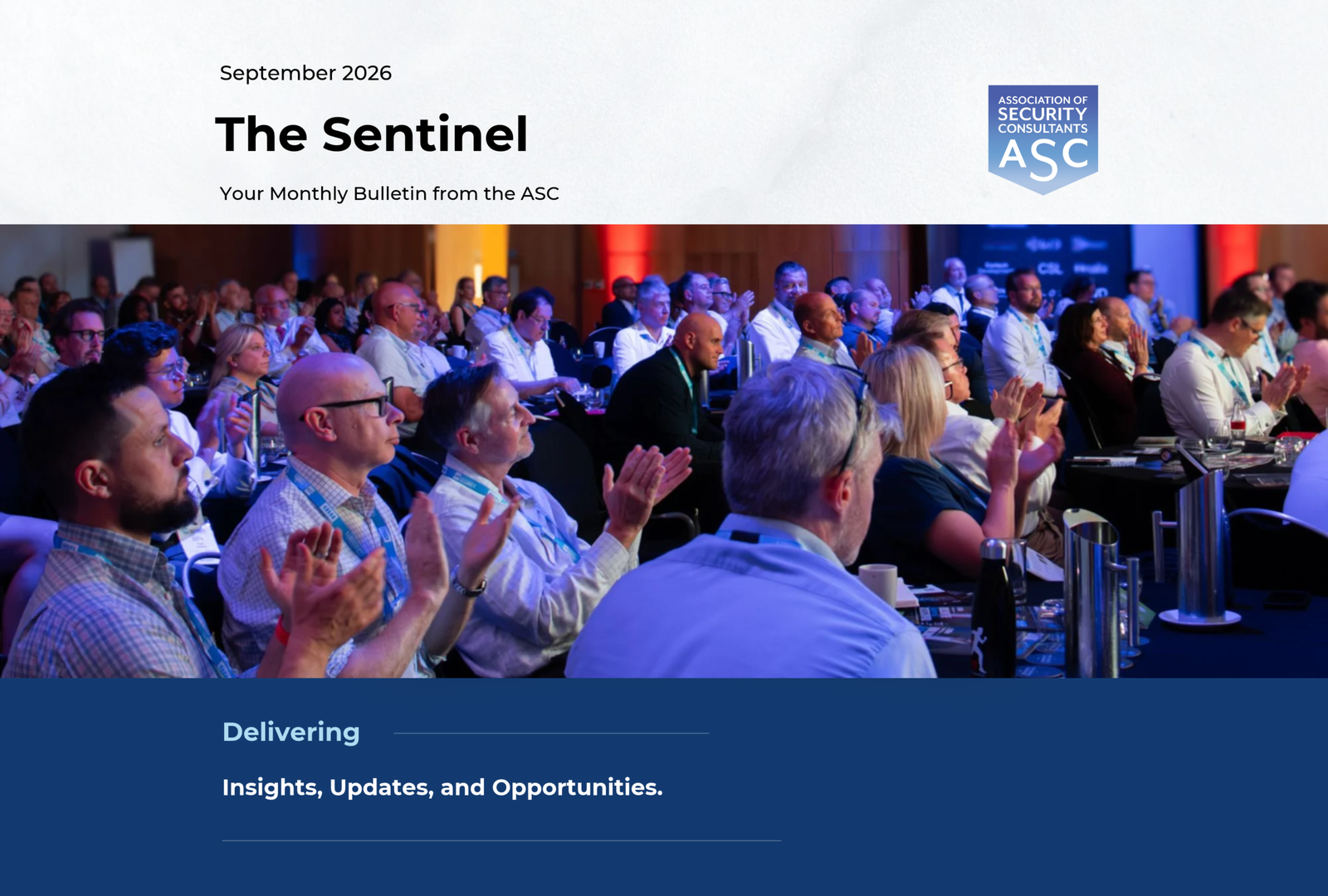
  • The October Sentinel

    The October Sentinel

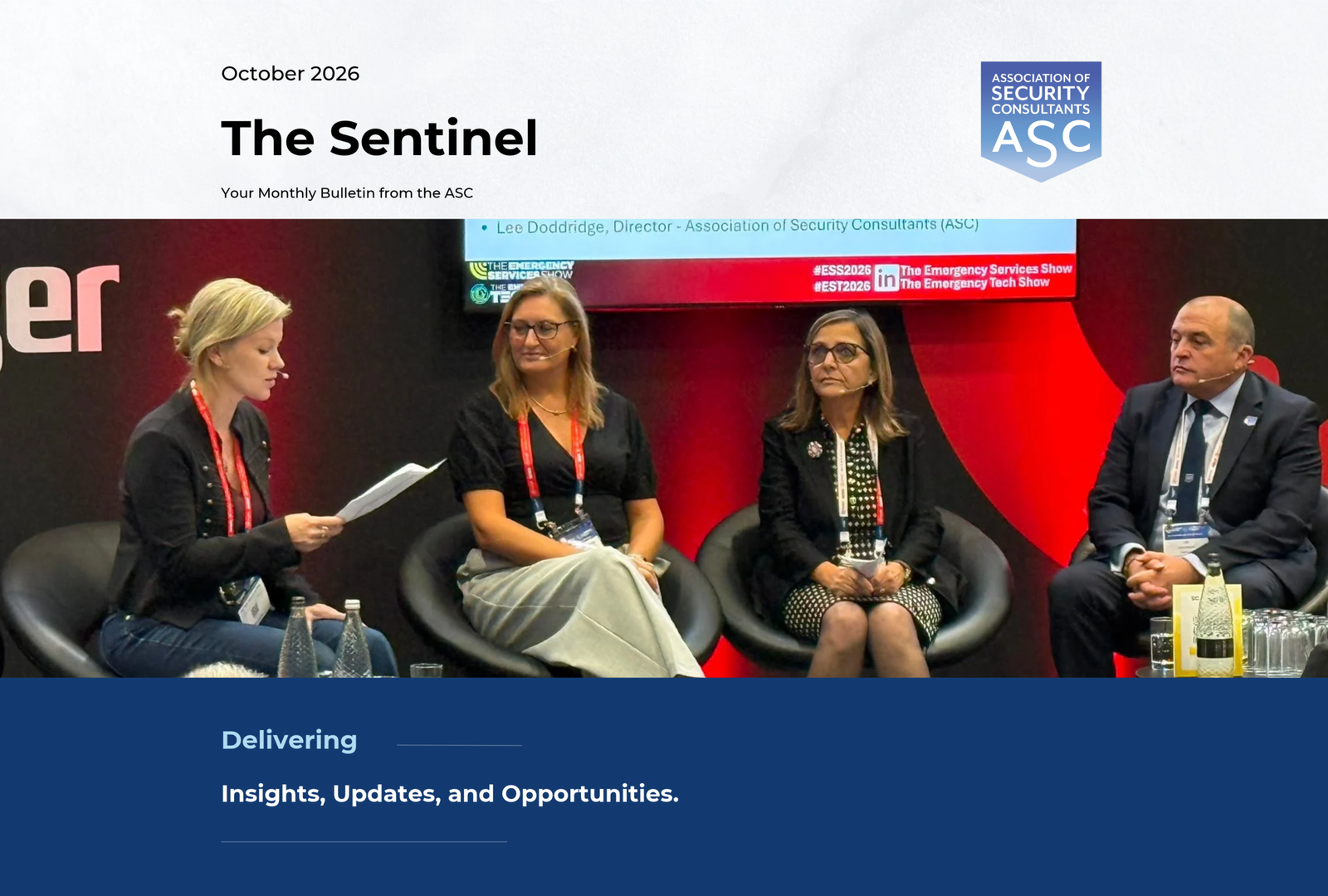
    The October edition of The Sentinel brings together the latest developments from across the security sector, with a focus on urban innovation, emerging technologies, and professional standards. With ConSeC 26 approaching, this issue explores the evolving security landscape and the role of consultancy, risk management, and resilience in modern environments.

    Inside, you’ll find industry updates, technical insights from specialists, news from across the ASC community, and developments supporting continued learning and professional growth.

    Enjoy The Latest Edition

  • Why Security Advisers Must Reframe the Debate

    Why Security Advisers Must Reframe the Debate

    Why Security Advisers Must Reframe the Debate
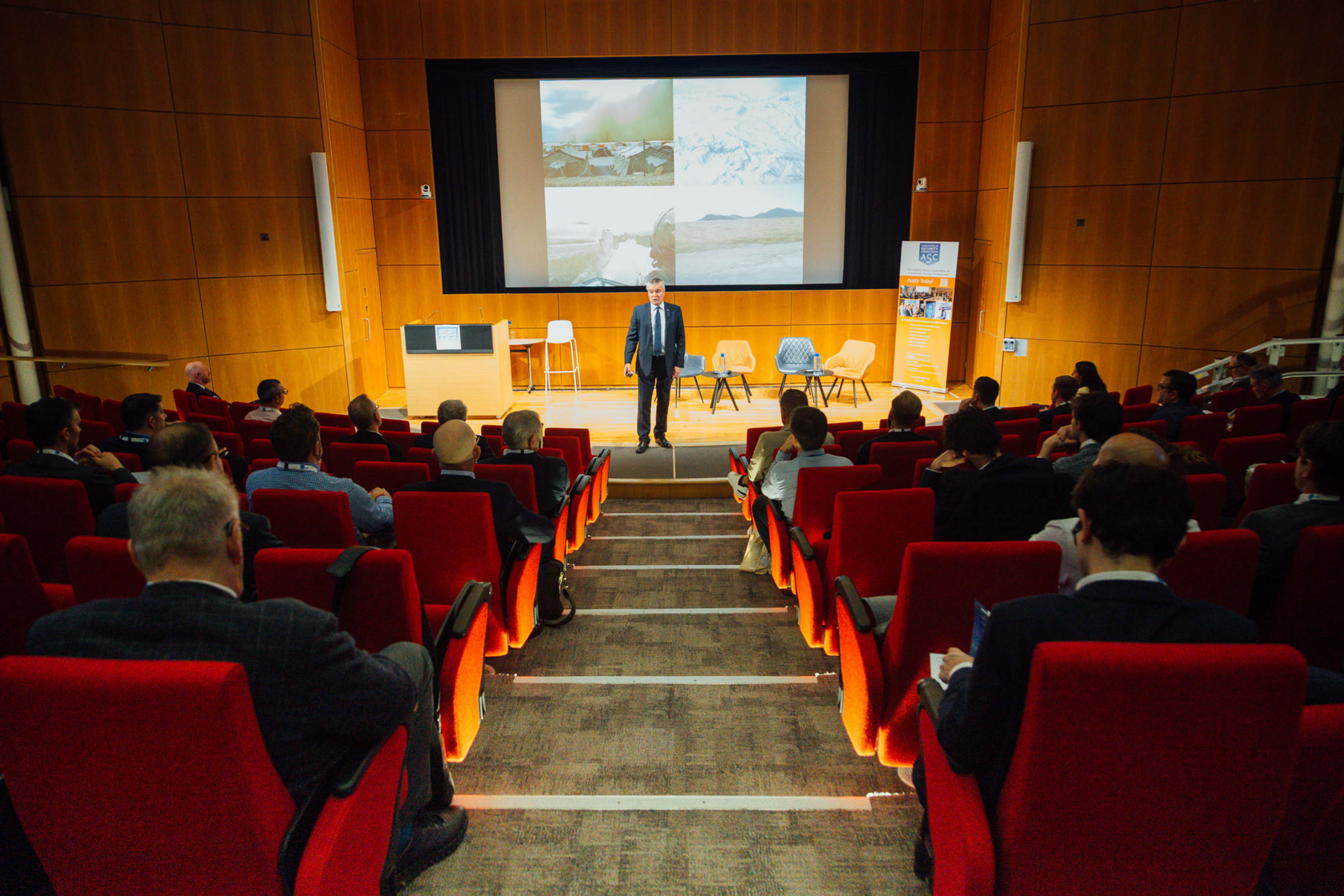
    ConSec Conference Auditorium

    How do we create cities that are not merely intelligent, but secure, resilient, safe, and capable of sustaining public confidence?

    From the perspective of security consultants, security advisors, and built-environment professionals, a Smart City is a complex socio-technical ecosystem comprising people, places, infrastructure, transport systems, utilities, public spaces, buildings, governance structures, and digital services.

    Technology may enable a Smart City, but security determines whether it can function effectively when subjected to disruption, criminality, terrorism, civil disorder, infrastructure failure, natural hazards, or societal change.

    The future of Smart Cities therefore depends not on how much technology they can deploy, but on how effectively security principles are embedded into their design, operation, and governance.

    “The United Nations projects that approximately 68% of the world’s population will live in urban areas by 2050, compared with around 55% today.”

    World Bank Group claims that cities already generate around 80% of global GDP and are the primary centres of economic activity, innovation, transport, logistics, and governance.

    This concentration creates extraordinary opportunities for productivity and sustainability. However, it also creates concentrations of risk.

    The challenge for Smart Cities is not simply one of efficiency. It is one of resilience under stress.

    One of the most persistent misconceptions surrounding Smart Cities is that security begins and ends with cyber security.

    This view is understandable. Modern Smart Cities rely heavily upon Internet of Things (IoT) devices, digital identity systems, data platforms, and autonomous and semi-autonomous technologies.

    However, cyber security represents only a single component of a much broader risk landscape.

    A Smart City can possess world-class cyber security while remaining vulnerable to hostile vehicle attacks, poor crowd management, inadequate emergency response, organised crime activity, and supply chain disruption.

    Built-environment security professionals have long understood the vulnerabilities that frequently emerge at the interfaces between systems rather than within individual systems. Smart Cities increase those interfaces exponentially.

    Smart Cities will not fail solely at the firewall. They will fail where physical, digital, operational, and human systems collide.
    ConSec Conference Auditorium
    CONTINUE THE DISCUSSION AT:
    THE ASC ANNUAL CONFERENCE & EXHIBITION
    29 October 2026 – Buxton Hall Conference Centre, Cambridgeshire
    Reserve your place
    ascuk.org/event/consec-26
    A fully accredited CPD event
  • The September Sentinel

    The September Sentinel

    Inside the September edition, we look back at the ASC Summer Seminar, explore updates on Martyn’s Law, the return of ConSeC 26, the ASC Awards 2026, new opportunities through the UK Defence Innovation Security Open Call, and the events and initiatives keeping the ASC community engaged this autumn.

    With technology continuing to expand what’s possible in security, the focus remains on how we turn information and innovation into better decisions. From industry developments to upcoming events and opportunities across the Association, this edition brings you what’s happening now and what’s next.

    Enjoy The Latest Edition

  • What Will Your Work Leave Behind? 

    What Will Your Work Leave Behind? 

    Every legacy begins with a contribution. Some change the way we think, others improve the way we work, and many quietly influence the standards that sculpt a profession. 

    “The achievements of an organisation are the results of the combined effort of each individual.” 

     — Vince Lombardi  

    Since its establishment in 1991, the Association of Security Consultants has worked to promote professionalism, independent expertise and the exchange of knowledge across the security sector. As the Association has grown, so too has its commitment to recognising the people and projects that continue to shape the profession.  

    The ASC Awards celebrate those contributions. Held annually by the Association of Security Consultants, they recognise outstanding achievements in consultancy, academic research and professional leadership while continuing a tradition of acknowledging work that has helped shape the security profession.  

    Nominations are open for the 2026 ASC Awards, and the Association looks forward to recognising another year of outstanding work from across the security community. 

    This year’s programme reflects the breadth of expertise found within the profession. 

    The Chairman’s Award recognises an individual whose contribution has made a lasting impact on the security profession. The Imbert Award celebrates exceptional master’s level research, recognising original thinking and academic work that demonstrates relevance to real-world security challenges. Continuing the legacy of one of the Association’s most respected figures, the Mike Cahalane MASC Award acknowledges consultancy projects, research, products and services that demonstrate measurable impact, while the Mike Cahalane RISC Award honours excellence in independent security consultancy and professional practice. Completing this year’s programme is the ASCEND Teams Award, recognising undergraduate teams whose collaborative research highlights innovation, teamwork and fresh thinking.  

    Although each award has its own criteria, they share a common purpose: recognising work that can be learned from, discussed and shared with the wider profession. Successful entries demonstrate clear objectives, thoughtful approaches, measurable outcomes and lessons that others can apply within their own organisations and projects. 

    The awards will be presented during the ASC Gala Awards Dinner on 29th October 2026, held at Hinxton Hall Conference Centre following ConSeC 26. Bringing together members, finalists, academics, consultants and industry guests, the evening has become a highlight of the Association’s annual calendar, providing an opportunity to celebrate achievement while reflecting on another year of progress across the profession. 

    As preparations continue for this year’s event, the Association invites professionals, researchers and eligible entrants to explore the award categories and put forward work they believe deserves recognition. Every nomination helps showcase the depth of expertise, innovation and dedication that continues to shape the future of security consultancy. 

    Explore the 2026 ASC award categories and submit your entry today: https://ascuk.org/awards/ 

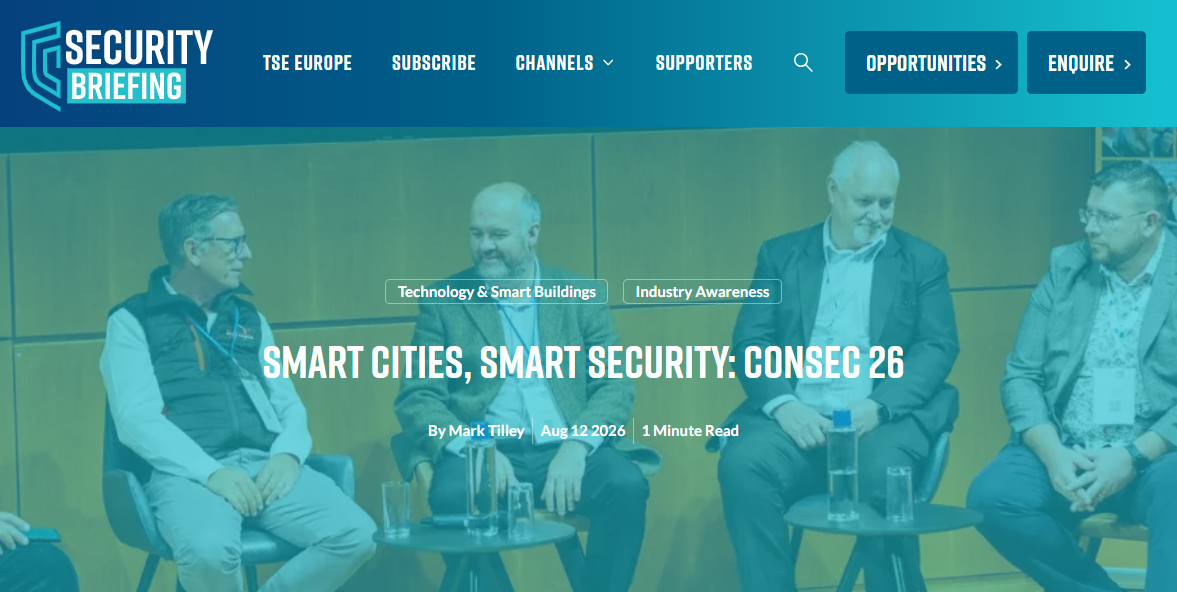
  • The Security Briefing Looks Ahead to ConSeC 26

    The Security Briefing Looks Ahead to ConSeC 26

    What does the future of security look like as our cities become smarter and more connected? Read the latest ConSeC 26 feature in The Security Briefing, exploring this year’s theme, programme and the conversations set to take place on 29th October at the Hinxton Hall.

    Read Full Piece

  • Does More Information Lead to Better Security Decisions? | ASC Summer Seminar 2026 

    Does More Information Lead to Better Security Decisions? | ASC Summer Seminar 2026 

    Access control systems record movement. CCTV captures thousands of hours of footage. Threat intelligence platforms issue alerts around the clock. Incident reports, visitor logs, cyber monitoring, travel advisories and business continuity updates all add another layer to an already crowded picture. 

    So, here’s the question: 

    If organisations have never had more information available, why do so many still struggle to make timely, confident security decisions? 

    The answer isn’t a lack of technology. 

    The answer is no; better decisions come from turning the right information into meaningful intelligence, supported by professional judgement and effective security processes. 

    “The essence of the independent mind lies not in what it thinks, but in how it thinks.”  
                                                                                                                         – Christopher Hitchens 

    Twenty years ago, the challenge was collecting information. Today, the challenge is deciding which information matters. Security professionals are expected to distinguish genuine risk from background noise, often within minutes and sometimes with incomplete information. Every delayed decision carries consequences but acting too quickly without context can be just as damaging.

    Information is Everywhere (But Security Intelligence Is Rare) 

    Most organisations have invested significantly in security technology over the last decade. Access control has become smarter. CCTV has become more intelligent. Sensors are more capable. Analytics are more sophisticated than ever before. Yet many security teams continue to work across disconnected systems. 

    Physical security, cyber security and operational teams often work from separate platforms. Information is stored in different places, reported in different formats and interpreted independently. Valuable intelligence exists, but it remains fragmented. 

    What’s the Cost of Information Overload? 

    Security has entered an age of information abundance. Every incident, movement and anomaly can be recorded, analysed and reported in real time. 

    When every system competes for attention, prioritisation becomes increasingly difficult. Teams spend valuable time validating information, switching between platforms and piecing together fragmented insights before they can respond with confidence. 

    The organisations that perform best aren’t necessarily those with the most technology. They’re the ones that have found ways to transform information into clear and actionable intelligence. 

    Simply introducing more technology does not solve this problem. When systems operate independently or produce information without sufficient context, they can create complexity rather than clarity. Effective decision-making depends on presenting the right information to the right people at the right time, enabling them to assess risk with confidence instead of navigating disconnected streams of data. 

    For many organisations, the real opportunity lies not in collecting more information but in making better use of the intelligence they already possess. Integrating systems, improving information sharing and establishing clear processes can transform data from a collection of isolated inputs into meaningful insight that supports timely and proportionate action. 

    Packaging Security Intelligence into Better Decisions  

    Information has little value unless it leads to informed action. While technology plays an increasingly important role in identifying risks and highlighting patterns, effective security still depends on the ability to interpret that information within the context of an organisation’s people, operations and objectives. 

    Turning insight into action requires more than sophisticated platforms or intelligent analytics. It calls for a clear understanding of risk, well-defined governance and the confidence to make decisions based on evidence rather than assumption. Technology can provide visibility, but it is professional judgement that determines how organisations respond and whether those responses are proportionate with timing and efficiency. 

    Ultimately, successful security is measured not by the amount of data an organisation collects, but by its ability to transform that data into decisions that protect people, assets and operations. In the increasing threat complexities ecosystem, the organisations that will be best prepared are those that can combine technology and experience for collaboration with sound professional judgement. 

    Continuing the Conversation 

    These questions sit at the heart of the ASC Summer Seminar 2026, taking place on 3rd September at the British Library Knowledge Centre. 

    Under the theme “From Insight to Action: Enhancing Decision Making Through Modern Security Technologies,” the seminar will examine how security professionals can make better operational decisions in increasingly complex environments. 

    Rather than focusing solely on new technologies, the programme explores how organisations can use them more effectively. The seminar also reflects the Association of Security Consultants’ wider priorities around professional development, governance, strategic growth, the SABRE Accreditation Scheme and support for the Chartered Security Professional (CSyP) pathway.  

    Join fellow security consultants, risk managers and industry leaders at the ASC Summer Seminar to investigate practical approaches to security executive determination. Register your interest now: https://ascuk.org/event/asc-summer-seminar-3rd-september/ 

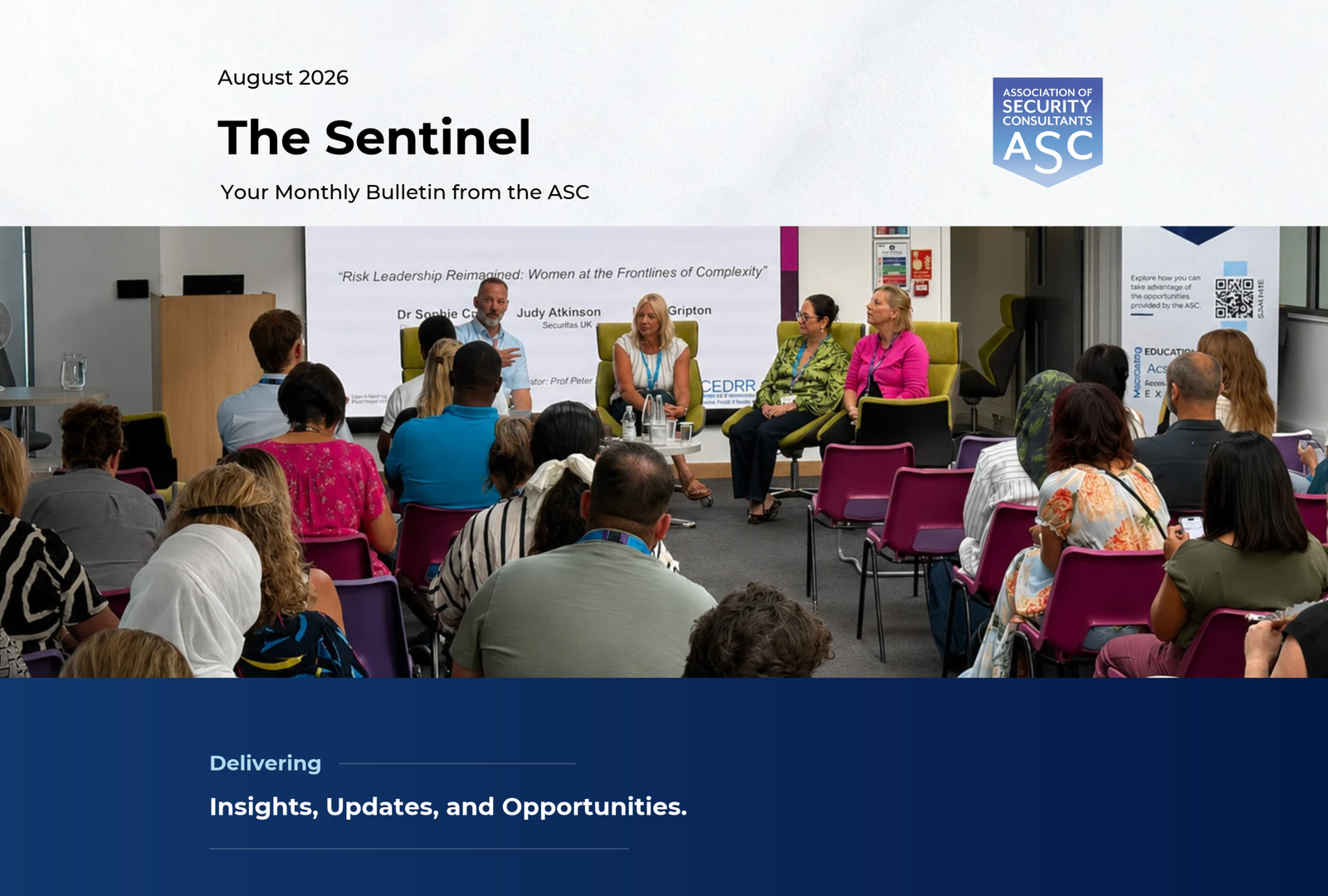
  • The August Sentinel

    The August Sentinel

    The August edition of The Sentinel brings together the latest updates from across the ASC, reflecting a busy first half of the year for the Association and the wider security sector. From recent events and industry engagement to members representing the ASC across the profession, this edition highlights the people and initiatives contributing to the security community.

    Inside, you’ll find updates from across the Association, a look ahead to the ASC Summer Seminar, ConSeC 26, the ASC Awards 2026 and upcoming partner events, alongside recognition of the members and partners supporting the profession through collaboration and leadership.

    Enjoy The Latest Edition

  • Press Release WISE UK x Tesco: A Landmark Day for Women in Security 

    Press Release WISE UK x Tesco: A Landmark Day for Women in Security 

    13 July 2026 marked a standout moment for the sector as more than 250 women and allies came together at Tesco Headquarters for an inspirational, heartwarming and memorable event designed to celebrate progress, amplify voices and strengthen connections across security. 

    Hosted by Rachel Bennett, Security and Shrink Director at Tesco, and organised by the WISE UK and Tesco team, the day brought together an impressive programme of 36 speakers to share journeys, stories and practical insight from across the industry. 

    Welcoming sponsors through exhibition stands and speaking slots, the event created space for conversation, collaboration and visibility, while reinforcing a shared mission to reduce the gender gap and support equity across the sector. Thank you to the sponsors Zinc Systems, Vars Technology, Smoke Screen, Convergint, Mitie, Duress, Association of Security Consultants, Abloy, Ocular, Todd Research and DNA Selecta.   

    The atmosphere throughout was unmistakably selfless and uplifting, with attendees describing a room full of energy, generosity and purpose, a celebration of what can happen when women and allies are given a platform to lead, learn and inspire. 

    Wellbeing, lived experience, and everyday support. 

    The speaker programme opened up vital conversations around wellbeing, inclusion and the realities many women face in and beyond the workplace. 

    Michelle Russell, Chief Executive of the Security Industry Authority, gave a forward-looking perspective on the future landscape of security, emphasising the importance of adaptation, standards and leadership as the industry evolves. 

    Nicola Sharp-Jeffs spoke on economic abuse and another type of security, broadening the conversation around the forms of harm that can shape lives both inside and outside the workplace. 

    Peachus Bra Fitting spoke on women’s wellness, bra fit and pain-free living, underlining how comfort and confidence can affect daily performance and quality of life. 

    Herizen followed with an important discussion on menopause in the workplace, exploring the need for education, training and awareness so organisations can better support colleagues through every stage of their careers. 

    Third App with Rosie McInerney shared powerful insight into her app, designed to record domestic abuse and feelings of uncertainty, helping build evidence for police reports when the time is right and giving survivors a more secure way to document what they experience. 

    Crunch Mediation’s Nermina Webster highlighted the value of workplace mediation before grievance policies, showing how early intervention can help resolve issues constructively and protect working relationships. 

    WalkSafe’s Asia Worgan discussed the WalkSafe app, which helps women track journeys and take the safer route home, offering a practical example of how technology can support personal safety in everyday life. 

    Technology, safety and the future of security 

    The event also examined how technology and intelligence are reshaping modern security practice. 

    Zinc Systems and CEO Joe Zielinski hosted a panel on supercharged cases and AI in intelligence, incident, and case management, featuring Lois Savage, Jo Bloomfield, and Laura Turner, exploring the capabilities of humans and AI and the future role of technology in mitigating crime and exploring the opportunities and responsibilities that come with smarter systems and data-led approaches. 

    Ocular Chantal Anabtawi covered the move from isolated systems to connected intelligence, reflecting the sector’s growing need for joined-up insight and stronger decision-making. 

    Helen Clayton hosted a panel on technology, and it is impacting communities with Iona Blake, Ann Marie Martin, Nicola Stitch, John Garnett and Matt Gilmartin, exploring the opportunities and responsibilities that come with smarter systems and data-led approaches. 

    Debbie Carter led a lone worker safety panel with Adam Gergiss, Lauren Macdonald and Laura Turner, shining a light on the realities of working alone and the importance of robust support, planning and protection. 

    Leadership, collaboration and a powerful close 

    Lisa O’Flynn from Abloy hosted a Women in Security Network panel that provided insights on imposter syndrome, connection, coaching, mentoring, being a sponsor and making promises that see everyone’s light shine with panellists Liz Lloyd, Emma Harris, Ruth Sharman, Demelza Staples, and Sarah Jane Cork.  

    Human Giving and the Impact, which saw Gaby Price, CEO of Women’s Aid in Luton, share how the Women’s network has supported the environment in the refuge, making it a temporary home for women and children fleeing domestic abuse. The power of giving and the importance of supporting women on career pathways and a journey of safety.  

    Simon Crane hosted a panel on designing safety for the Association of Security Consultants, with Kate Dawes, Michelle Elkins, and Leigh Harper, focusing on the value of shared expertise, communication and collaborative design in creating safer environments. 

    The day concluded with a final keynote from Figen Murray, whose closing message brought the audience together around the power of action, resilience and collective responsibility. 

    With thanks to the sponsors, speakers, guests, and Tesco for hosting such an amazing event, which was a clear reminder of the impact of connection, visibility, and shared purpose. The day was photographed by Senem Peace, who is the Women in Security official photographer and has captured the event to provide memories for everyone who attended.  

    WISE UK, founded by Liz Lloyd, Emma Harris and Sarah-Jane Cork, continues to drive connection, empowerment and opportunity across the security sector and beyond. This landmark day showed exactly why that mission matters. 

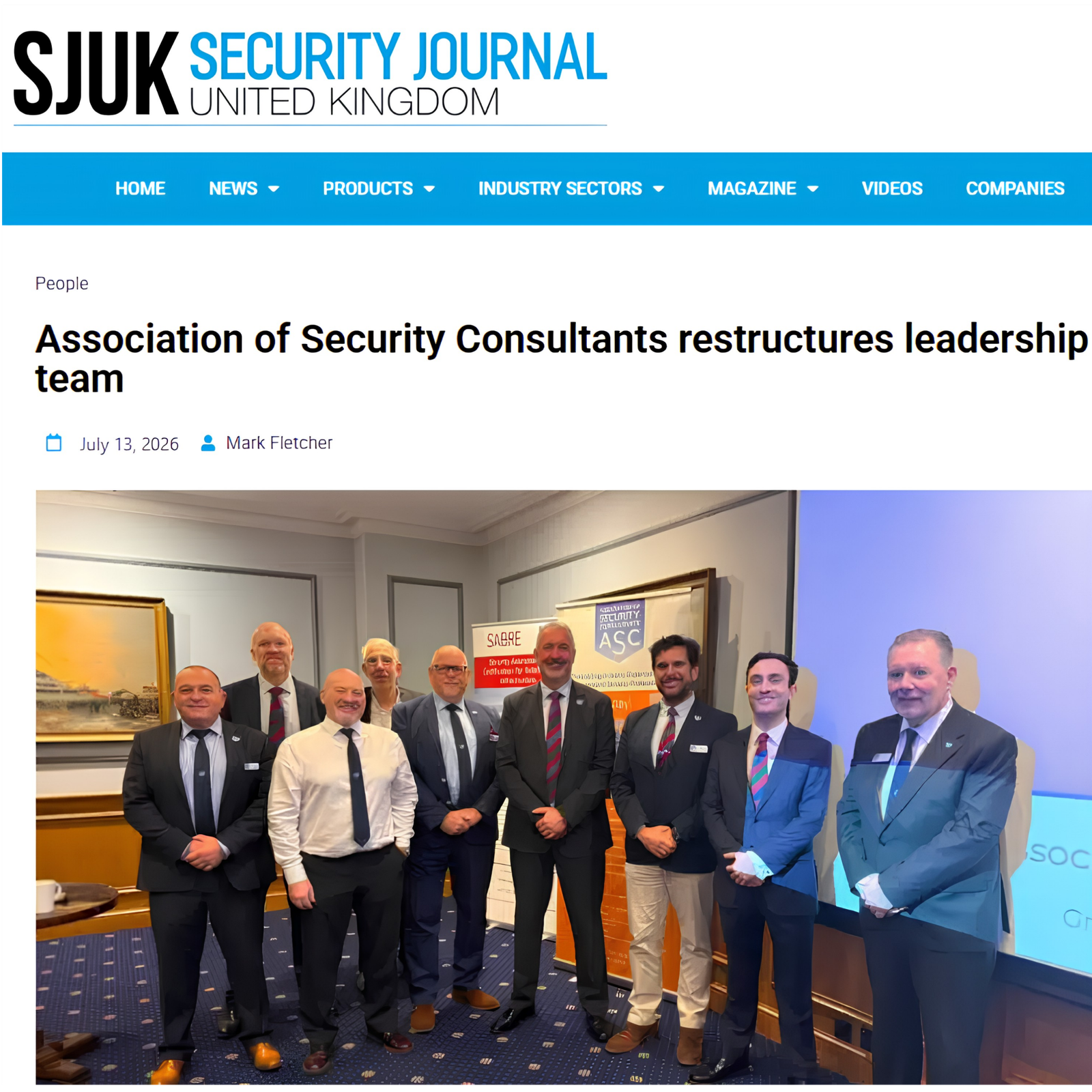
  • SJUK Shares ASC’s Leadership Update for 2026

    SJUK Shares ASC’s Leadership Update for 2026

    Security Journal United Kingdom SJUK Features ASC’s 2026 Board of Directors Announcement.

    View the full press release